
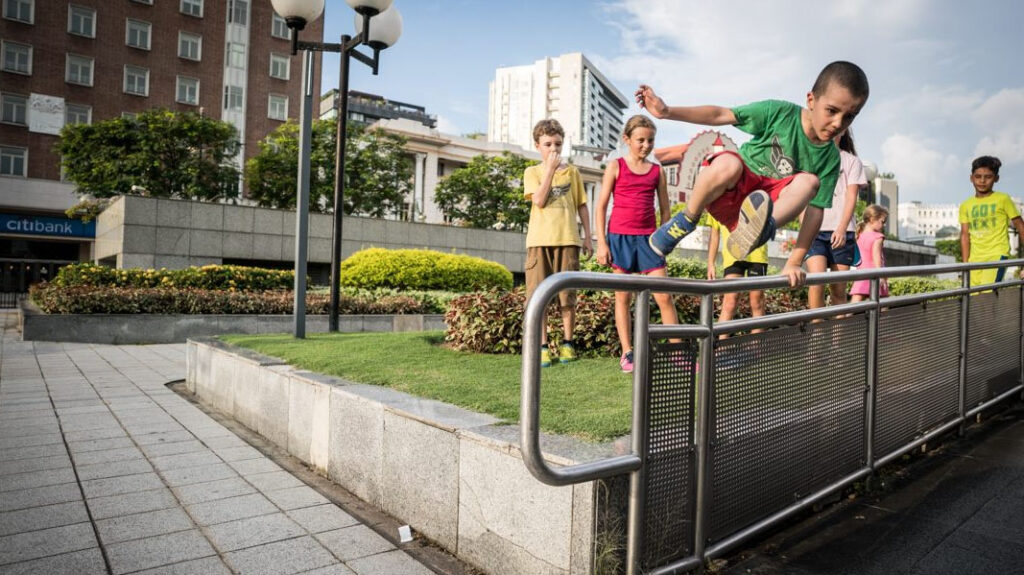
Photo: A child vaults a railing outdoors. Courtesy of Superfly.sg.
Teaching transferable movement skills that show up on the playground, in hallways, and in everyday life.
Portable and Personal
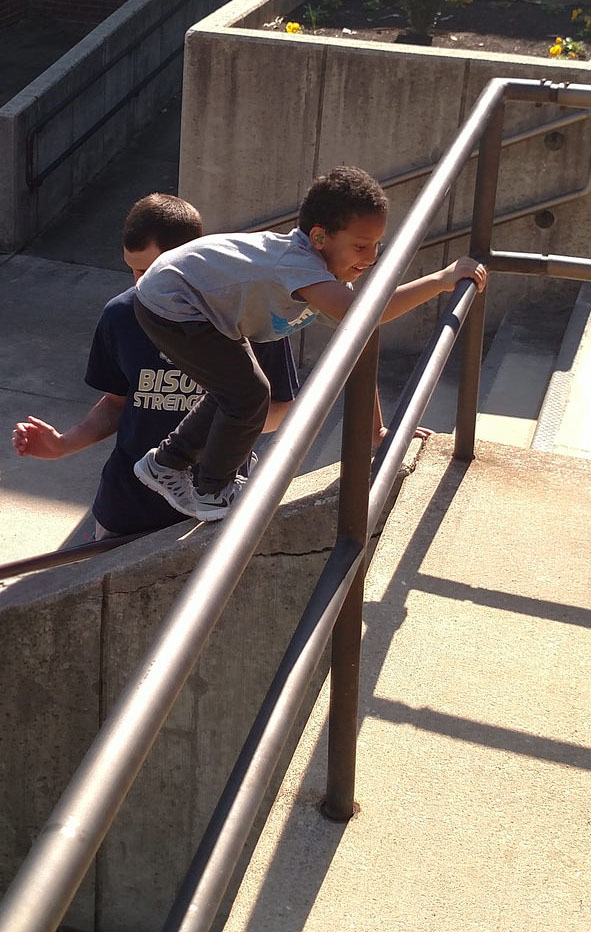
Two kids are outside, moving through a concrete courtyard with rails, ledges, and ramps. One carefully tests the next foothold before committing. The other follows, eyes up, hands ready, choosing a lower option that matches his comfort level.
They are practicing judgment, balance, and decision-making in a real environment, using both mental and physical skills learned in Physical Education.
SHAPE Spotlight
Standard 4.5.8: Identifies physical activity opportunities outside of physical education class.
Standard 4.8.7: Examines opportunities and barriers to participating in physical activity outside of physical education class.
Why Parkour Builds Portability in PE
PE is not only about performance during class. It is about what students can do when the context changes: different surfaces, different obstacles, different spacing, different levels of comfort.
Parkour builds portability because students practice three things over and over, in lots of different environments, while the learning goal stays consistent.
1) Read the environment: Students learn to scan for information: edges, heights, traction, hand support, and landing zones. This becomes a habit: look first, then move.
2) Choose an appropriate challenge: Parkour is naturally self-scaling. There are multiple valid routes, and students can dial difficulty up or down without being separated from the class.
3) Move with control: The goal is not “big tricks.” The goal is safe, repeatable movement: balance, stepping, jumping, landing, climbing, and vaulting with appropriate control.
Bottom line: Parkour makes “transfer” visible. Students learn skills once, then use them everywhere.

“Risk Assessment” as a Teachable Skill
One of the most misunderstood parts of parkour in schools is risk.
Parkour, taught well, does not ignore risk. It teaches risk literacy.
“Risky play allows children to engage in risk assessment, negotiate risk, and understand their limits.”1
With supervision and clear constraints, students practice:
-
Checking stability before committing
-
Choosing a height and speed they can control
-
Using hands for support
-
Stopping when unsure
-
Repeating the safe version before leveling up
This is responsible decision-making, not thrill-seeking. It is also a direct pathway to autonomy and engagement, which motivation research consistently links to sustained participation.
References
1. Spencer, R. A., et al. Early childhood educator perceptions of risky play in an outdoor loose parts intervention (2021).
“Risky play allows children to engage in risk assessment, negotiate risk, and understand their limits.”
Read the article
2. SHAPE America. New National Physical Education Standards (2024).
Relevant indicators for this article include Standard 4.5.8 and Standard 4.8.7, which address physical activity opportunities and barriers outside of PE class.
View the standards
Resources and Next Steps
- For Teachers: Explore our School Parkour Programs for lesson plans and equipment.
- For Coaches: Check out our Instructor Certifications
- For practitioners: See our Getting Started in Parkour Guide
Enjoyed this? Get Movement Matters — monthly research, case studies, and activities.
Subscribe